RF video overlay carries broadcast television on a dedicated 1550 nm wavelength alongside your PON data wavelengths, so TV never consumes data bandwidth. In practical FTTH designs — typically 1:32 or 1:64 splitting — an EDFA is required: a 1550 nm transmitter alone (even at 10 mW / 10 dBm) cannot deliver usable RF level to the subscriber after splitter loss. This guide covers the wavelength plan, equipment chain, EDFA sizing, power budget tables, and a full 1,000-home worked example.
1. Quick Answer / Key Takeaways
- 1550 nm is the video wavelength. It sits in the ITU-T enhancement band (G.984.5) — the only window left free once the PON itself has taken 1310 nm and 1490 nm, and conveniently the only one an EDFA can amplify.
- Broadcast TV never touches your data budget. Downstream data rides on 1490 nm (GPON) or 1577 nm (XGS-PON); video rides on 1550 nm. Adding RF video does not slow down internet service.
- You need an EDFA in almost every real deployment. With 1:32 or 1:64 splitting, a 1550 nm transmitter alone lands the subscriber signal at the bottom of the CATV ONT's receiving window with no engineering margin — and at 1:64 it falls below the window entirely.
- The subscriber needs an ONT with a CATV (RF) port. A standard data ONT has no RF stage, so it cannot deliver television. A CATV ONT (for example 2GE+CATV+1POTS+WiFi5) separates the 1550 nm video from the data internally and feeds an F-type RF port to the subscriber's set-top box.
- Watch the ONT's upper limit. FOT's CATV ONTs accept −15 to +2 dBm on the video wavelength. A low split ratio combined with a short run will deliver more than +2 dBm, and then you need an attenuator.
- Budget impact is small. For a 1,000-home project, the CATV increment — transmitter plus EDFA — is roughly US$1.85 to $2.25 per home of central-office equipment cost.
2. Where 1550 nm Sits in the Wavelength Plan
A PON carries several wavelengths on one fibre. Video overlay adds one more.
| Direction | Service | Wavelength | Standard |
|---|---|---|---|
| Downstream | GPON data | 1490 nm | ITU-T G.984 |
| Downstream | XGS-PON data | 1577 nm | ITU-T G.9807.1 |
| Downstream | RF video (CATV / SAT-IF) | 1550 nm | ITU-T G.984.5 enhancement band |
| Upstream | GPON data | 1310 nm | ITU-T G.984 |
| Upstream | XGS-PON data | 1270 nm | ITU-T G.9807.1 |
3. The Signal Path: Headend to TV
Today's FTTH networks are single-fibre: one fibre carries all three wavelengths from the central office to the subscriber. The chain is always the same:
RF source → 1550 nm transmitter + GPON OLT → WDM EDFA → PLC splitter → feeder fibre → drop fibre → CATV GPON ONT
Note the two inputs into the EDFA chassis: the transmitter feeds the video in and the OLT feeds the 1310/1490 nm data in. The WDM EDFA amplifies the video and combines both onto its output ports — there is no separate combiner panel. Video and data then travel together through the splitter and the outside plant.
At the home, the CATV ONT contains its own WDM filter: it separates the 1550 nm video from the data wavelengths internally, converts the video back to RF, and puts it on an F-type connector for the set-top box. One box gives the subscriber RF for the set-top box, Ethernet for internet, and — depending on the model — POTS and Wi-Fi.
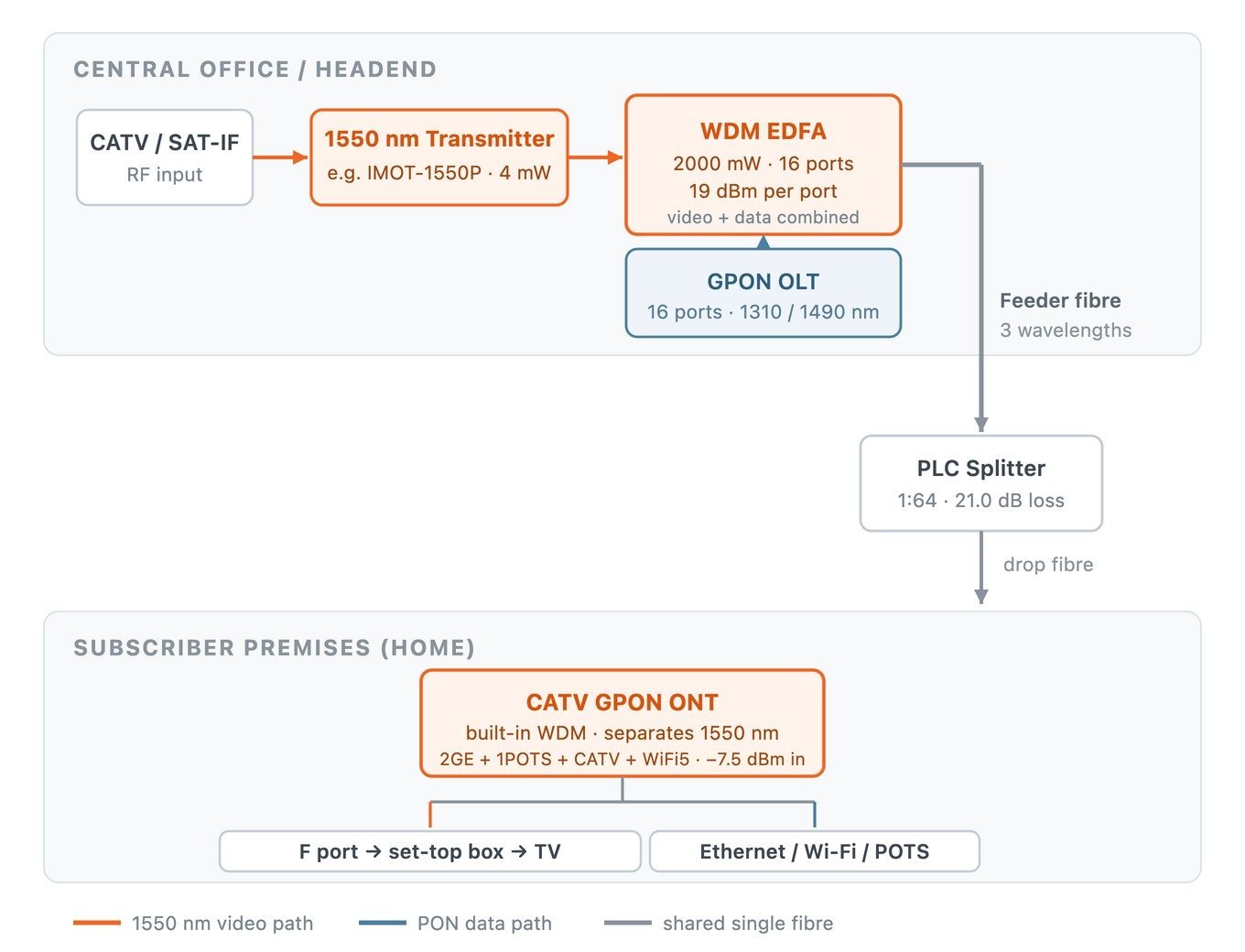
4. The Equipment Chain, Node by Node
| # | Node | What it does | Key specs to check | FOT example |
|---|---|---|---|---|
| 1 | RF optical transmitter | Converts the RF signal (47–862 MHz CATV, and optionally 950–2600 MHz SAT-IF) into modulated 1550 nm light | Output power, CNR, CTB/CSO, flatness, RF input level | IMOT-1550P (1U, 2–12 mW), FCOT-2600DB (1U, 4–10 mW, CATV + SAT-IF on one output) |
| 2 | GPON OLT (data source) | Terminates the PON. Its 1490 nm downstream and 1310 nm upstream are fed into the WDM EDFA and merged with the video there | Port count, optics class (B+/C+), logical reach | 16-port GPON OLT |
| 3 | WDM EDFA | Does two jobs in one chassis: amplifies the 1550 nm video and combines it with the OLT's 1310/1490 nm data onto each output port | Saturated output power, per-port output power, port count, noise figure, input power range | EDFA-1550S (13–27 dBm), EDFA-1550H (27–40 dBm total, up to 32 ports) |
| 4 | PLC splitter | Distributes to subscribers | Split ratio and insertion loss | PLC splitters |
| 5 | CATV GPON ONT (CPE) | Built-in WDM splits the 1550 nm video from the 1310/1490 nm data; converts video back to RF and outputs it on an F port for the set-top box | CATV receiving window, RF output level, CATV bandwidth, data ports, Wi-Fi | 2GE+1POTS+CATV+WiFi5 xPON ONT (−15 to +2 dBm input, 76 ± 2 dBμV out, 47–1000 MHz), 2GE+CATV+WiFi5 xPON ONT |
5. Power Budget: How to Size the EDFA
The video path is budgeted separately from the data path. Different wavelengths, different transmit levels, different amplifiers.
5.1 Design assumptions used in this guide
| Item | Value |
|---|---|
| Fibre attenuation @ 1550 nm | 0.25 dB/km (G.652D design value) |
| PLC splitter loss, incl. excess | 1:8 = 10.5 dB · 1:16 = 14.0 dB · 1:32 = 17.5 dB · 1:64 = 21.0 dB |
| Connectors, splices, adapters | 1.5 dB total |
| Design margin (ageing, repairs, temperature) | 1.5 dB |
| CATV receiving window at the ONT | −15 to +2 dBm (FOT CATV ONT; AGC holds RF output at 76 ± 2 dBμV across this range) |
| Design target receive level at the CATV ONT | −6 dBm |
WDM combining happens inside the WDM EDFA here and is already reflected in the per-port output figure, so it is not budgeted again. With a standalone combiner instead, add roughly 0.6 dB.
5.2 Why a transmitter alone is not enough
Take a 1550 nm transmitter at its highest common FTTH rating, 10 mW (10 dBm), with no EDFA, 10 km reach:
Path loss at 10 km = splitter loss + 2.5 dB fibre + 1.5 dB connectors and splices + 1.5 dB margin.
| Split ratio | Receive level at CATV ONT | Verdict |
|---|---|---|
| 1:8 | −6.0 dBm | Works, but this is not how FTTH is built |
| 1:16 | −9.5 dBm | Inside the window, little margin |
| 1:32 | −13.0 dBm | Near the floor — only 2 dB left |
| 1:64 | −16.5 dBm | Below the −15 dBm floor — no picture |
This assumes the highest output commonly used in FTTH. With the 4 mW transmitter in most small headends, 1:16 lands at −13.5 dBm and 1:64 reaches −20.5 dBm, roughly 5 dB below what the ONT needs. That is why RF overlay projects include an EDFA — not "for extra reach", but because without one a 1:64 design does not work.
5.3 Sizing table: required EDFA output
Target receive level −6 dBm (CATV ONT).
| Split ratio | Reach | Total path loss | Required EDFA output | Suggested model |
|---|---|---|---|---|
| 1:16 | 5 km | 18.25 dB | 12.25 dBm (17 mW) | EDFA-1550S-13 (≥20 mW) |
| 1:16 | 10 km | 19.50 dB | 13.50 dBm (22 mW) | EDFA-1550S-14 (≥25 mW) |
| 1:16 | 20 km | 22.00 dB | 16.00 dBm (40 mW) | EDFA-1550S-16 (≥40 mW) |
| 1:32 | 5 km | 21.75 dB | 15.75 dBm (38 mW) | EDFA-1550S-16 (≥40 mW) |
| 1:32 | 10 km | 23.00 dB | 17.00 dBm (50 mW) | EDFA-1550S-18 (≥63 mW) |
| 1:32 | 20 km | 25.50 dB | 19.50 dBm (89 mW) | EDFA-1550S-20 (≥100 mW) |
| 1:64 | 5 km | 25.25 dB | 19.25 dBm (84 mW) | EDFA-1550S-20 (≥100 mW) |
| 1:64 | 10 km | 26.50 dB | 20.50 dBm (112 mW) | EDFA-1550S-21 (≥125 mW) |
| 1:64 | 20 km | 29.00 dB | 23.00 dBm (200 mW) | EDFA-1550S-23 (≥200 mW) |
All figures above are per port. On a multi-port chassis, per-port output is the chassis total less the internal splitter loss — not the total divided by the port count.
6. Do You Need an EDFA? Two Decision Lines
Line 1 — Service: does the project carry RF video?
- RF video / CATV service → yes, plan for an EDFA.
- IPTV or pure data → no. IPTV rides on the data wavelength like any other IP traffic. There is no 1550 nm transmitter, no amplifier, and no CATV ONT at the home.
Line 2 — Engineering: split ratio × reach
Section 5.2 quantifies it. Below 1:16 and short reach, a transmitter alone can physically deliver a signal. By 1:32 the CATV ONT has only about 2 dB left above its floor, and at 1:64 there is no picture at all. Since FTTH projects are normally designed at 1:32 or 1:64, the two lines almost always agree: RF video means an EDFA.
7. Worked Example: A 1,000-Home FTTH Project with CATV
7.1 Sizing
| Question | Answer | Consequence |
|---|---|---|
| Homes | 1,000 | |
| OLT | 16-port GPON | 16-port GPON OLT |
| Homes per PON port | 1,000 ÷ 16 ≈ 64 | Split ratio 1:64 |
| Video wavelength | 1550 nm | |
| Transmitter | 4 mW (6.0 dBm) | Within EDFA input range (−10 to +10 dBm) |
| EDFA | 2,000 mW total (33.0 dBm), 16 ports, WDM | EDFA-1550H class |
| Per-port output | 19.0 dBm | 33 dBm less the 14 dB of the internal 1:16 splitter |
| CPE | CATV GPON ONT with RF port | 2GE+1POTS+CATV+WiFi5 xPON ONT, installed in the home, F-type RF port to the set-top box |
7.2 Verify the budget
| Term | Value |
|---|---|
| EDFA output per port | +19.0 dBm |
| 1:64 splitter | −21.0 dB |
| Fibre, 10 km @ 0.25 dB/km | −2.5 dB |
| Connectors, splices, adapters | −1.5 dB |
| Design margin | −1.5 dB |
| Receive level at the CATV ONT | −7.5 dBm |
−7.5 dBm sits inside the CATV ONT's window of −15 to +2 dBm, with 7.5 dB above the floor and 9.5 dB below the ceiling. The design is sound.
How far can this design reach? The link has 7.5 dB of headroom before the −15 dBm floor — roughly 30 km. GPON itself limits logical reach to 20 km, so the video path is not the distance constraint; the PON data path is. Size the video chain for the split ratio, not the distance.
7.3 Central-office equipment budget
Indicative ranges as of October 2026, for budget planning only — confirm with FOT before committing.
| Item | Qty | Indicative unit price | Line total |
|---|---|---|---|
| 16-port GPON OLT | 1 | US$1,600 – 2,100 | US$1,600 – 2,100 |
| 1550 nm optical transmitter | 1 | US$350 – 450 | US$350 – 450 |
| 16-port WDM EDFA, 2,000 mW | 1 | US$1,500 – 1,800 | US$1,500 – 1,800 |
| Central-office subtotal | US$3,450 – 4,350 |
Excludes ONTs, PLC splitters, drop cable, and outside-plant passive hardware.
The CATV increment alone — transmitter plus EDFA — is US$1,850 to $2,250, or US$1.85 to $2.25 per home across 1,000 homes. That is the number that usually decides the business case.
8. Two Mistakes That Are Easy to Make
8.1 Over-powering the receiver
The CATV ONT's window runs up to +2 dBm, which is generous — that is why a 19 dBm-per-port EDFA is safe across the split ratios FTTH normally uses. The trouble starts when two conditions combine: a low split ratio and a short run. That is exactly the MDU, campus and in-building case, where a splitter of 1:8 or 1:16 sits a kilometre or two from the headend.
| Case with a 19 dBm/port EDFA | Receive level at CATV ONT | Verdict |
|---|---|---|
| 1:64, 10 km | −7.5 dBm | Correct (design case) |
| 1:32, 10 km | −4.0 dBm | Correct |
| 1:16, 10 km | −0.5 dBm | Correct, but only 2.5 dB below the ceiling |
| 1:16, 1 km | +1.8 dBm | Just inside — no margin left |
| 1:8, 10 km | +3.0 dBm | Above the +2 dBm maximum — fit an attenuator |
| 1:8, 5 km | +4.3 dBm | Well above maximum — attenuator or lower-power EDFA |
Above +2 dBm you are out of specification and the RF output distorts. Size for the split ratio and the shortest run in the network, not just the longest — and where a low-ratio section shares the chassis, add attenuation there or pick a lower output class.
8.2 Sizing the EDFA before knowing the split ratio
Port count and output power both follow from the split ratio, which follows from how many homes sit behind each PON port. A quote request that specifies "a 16-port EDFA" without the split ratio and target reach cannot be sized correctly. See the checklist below.
9. RF Overlay vs IPTV vs RFoG
| RF overlay (1550 nm) | IPTV | RFoG | |
|---|---|---|---|
| Video delivery | Analogue RF on a dedicated wavelength | IP streams on the data wavelength | RF over a fibre PON, SCTE 174 |
| Consumes PON data bandwidth | No | Yes | Separate wavelength |
| What the ONT's RF port feeds | The subscriber's existing RF set-top box | — | The subscriber's existing RF set-top box |
| Box needed at each TV | RF set-top box (as with any RF CATV feed) | IP set-top box or app per TV | RF set-top box |
| Extra headend equipment | Transmitter + WDM EDFA | None beyond the IPTV platform | Transmitter + EDFA, return-path handling |
| Typical adopter | Telco / ISP adding TV to an FTTH build | ISP with ample data capacity | Cable operators migrating HFC to fibre |
| Coexistence with existing PON | Designed for it | N/A | Can overlay an existing PON |
Choose RF overlay when you want television that does not eat into your data capacity and want to keep using standard RF set-top boxes. Choose IPTV when data capacity is not a constraint and you want per-channel control.
10. Design Checklist
Confirm each of these before requesting a quote:
- Number of homes, and homes per PON port → split ratio
- Target reach from the central office to the furthest subscriber
- Shortest run too — low split ratio plus short reach is where the ONT's +2 dBm ceiling bites
- PON generation in use: GPON, XGS-PON, or mixed
- Whether the service is RF video, IPTV, or data only (determines whether an EDFA is needed at all)
- CATV channel plan: frequency range and channel count
- Whether satellite IF (950–2600 MHz) must ride the same fibre
- Subscriber terminal: CATV ONT required (receiving window, RF output level, CATV bandwidth)
- Data and voice ports needed at the home (GE ports, POTS, Wi-Fi standard)
- EDFA port count and required per-port output power (size from the per-port spec, not the chassis total)
- Design margin your organisation requires (this guide uses 1.5 dB)
- Rack space and power available at the central office
The two items most often missing from an enquiry are the subscriber split ratio and the per-subscriber bandwidth target. Together they determine how many OLT ports you need — and only then can the matching WDM EDFA port count and output power be selected. Enquiries that skip them usually come back for two or three rounds of clarification.
11. Frequently Asked Questions
Can RF video be added to an existing GPON network?
Yes. The 1550 nm window is reserved for video in every PON generation, so the existing ODN — fibre, splitters, closures — is reused. You add a transmitter, an EDFA, and swap the subscribers onto CATV-capable ONTs. No change to the OLT or the outside plant.
Will adding television slow down subscribers' internet?
No. Video travels on 1550 nm and data on 1490 nm (or 1577 nm for XGS-PON). They are separate wavelengths on the same fibre and do not share capacity.
Do subscribers need a different ONT?
Yes — a CATV ONT. A standard data ONT has no RF stage, so it cannot deliver television even though the 1550 nm light arrives at its port. A CATV ONT such as the 2GE+1POTS+CATV+WiFi5 xPON ONT does the WDM separation internally and gives you an F-type RF port for the set-top box alongside Ethernet, POTS and Wi-Fi — one box instead of a receiver plus a separate ONU.
Do 1550 nm and 1490 nm interfere with each other?
Not in a correctly specified design. The wavelengths are separated by tens of nanometres and the WDM components are specified for isolation between them. Isolation should be verified against the component data sheet, particularly in single-fibre designs.
How far can a 1:64 RF overlay reach?
In the worked example above, roughly 30 km before the receive level reaches the CATV ONT's −15 dBm floor. GPON limits logical reach to 20 km, so the PON data path governs the design, not the video path.
Can CATV and satellite IF share one transmitter?
Yes, if the transmitter covers both bands. The FCOT-2600DB covers 47–2600 MHz — CATV at 47–862 MHz and SAT-IF at 950–2600 MHz — on a single output. Note that most CATV ONTs receive CATV up to 1000 MHz only, so check the ONT band if satellite IF is in scope.
Is an EDFA needed for IPTV?
No. IPTV is ordinary IP traffic on the data wavelength. The 1550 nm chain — transmitter, EDFA, CATV ONT — exists only for RF video.
Can the EDFA be oversized "for future growth"?
Only within limits. The CATV ONT's video input tops out at about +2 dBm, so an EDFA sized for a much lower split ratio — or a much shorter run — than the network actually uses will need attenuation at the ONT. Size for the planned split ratio and shortest reach, and leave margin in the design budget instead.
12. Related Equipment
- IMOT-1550P 1550 nm optical transmitter — 1U, 2–12 mW selectable output, 47–862 MHz (1000 MHz optional)
- FCOT-2600DB 47–2600 MHz CATV & SAT-IF optical transmitter — 1U, 4–10 mW, CATV and satellite IF on one output
- EDFA-1550H high-power EDFA — 27–40 dBm saturated output, 4–32 ports
- EDFA-1550S standard EDFA — 13–27 dBm, 1–8 ports, 1U
- 16-port GPON OLT · 8-port GPON OLT
- Fibre optic PLC splitter
- 2GE+1POTS+CATV+WiFi5 xPON ONT — CATV 47–1000 MHz, −15 to +2 dBm video input, 76 ± 2 dBμV RF output, feeds the set-top box
- 2GE+CATV+WiFi5 xPON ONT — CATV 47–1000 MHz, ≥76 dBμV RF output
Planning an RF video overlay? Send FOT your home count, split ratio, target reach, and channel plan, and we will size the transmitter, EDFA port count, and output power for your network.
Fiber Optic Telecom (FOT) · sales@fiberoptictel.com · +86-158 0028 0091 · No.195 Shuixi Road, Huangpu District, Guangzhou, China
Specifications and prices in this article are indicative and reflect published catalogue data as of October 2026. Prices are budget-planning figures and vary with configuration, quantity, and port options. Confirm exact model, output power, and compatibility with FOT before ordering.